Hot Water Slab Leak Repair in Manteca, CA
When hot-water lines rupture beneath your concrete foundation, they waste gallons of heated water every hour, send utility bills soaring, and create radiating hot spots across your floors. We isolate and repair hot subterranean lines swiftly before foundation moisture expands.
Why Hot Water Lines Fail First in Manteca Foundations
Over 80% of all residential foundation plumbing failures occur on the hot water side. In Manteca, homes built throughout the 1970s, 80s, 90s, and early 2000s feature copper lines cast directly into sand or gravel beneath concrete without continuous expansion sleeving. Whenever hot water is drawn for a shower, laundry, or dishes, copper tubing rapidly heats to 120-140 degrees Fahrenheit, physically expanding in length. When the tap is turned off, the copper cools and contracts back to its resting length.
This endless thermal cycling causes subterranean pipes to rub continuously against jagged aggregate, coarse sand, and concrete tie-wires. Over 15 to 30 years, mechanical abrasion wears the copper wall thin from the outside while mineral-rich San Joaquin Valley hard water corrodes it from the inside, eventually triggering a rupture. If you suspect an active leak, securing experienced slab leak repair in Manteca is critical to preserving your flooring and foundation.
Four Signs of a Hot Water Line Leak Under the Slab
Because hot water behaves differently than cold water, it produces distinctive symptoms throughout the home:
Distinct Warm Spot on Floor Manteca
Walking across kitchen tile, hallway laminate, or bedroom carpet and feeling an isolated hot or warm area is the hallmark symptom of escaping 120-degree water heating the concrete from underneath.
Water Heater Running Constantly Manteca
If your gas burner roars continuously or the electric heating element never shuts down despite no hot water being actively used, the tank is endlessly firing to heat water escaping into the ground.
Dramatic Spike in PG&E Gas or Electric Bills
Heating 200 to 500 gallons of wasted water per day results in massive energy consumption. Homeowners often discover a hot water slab leak only after receiving an astronomical energy utility bill.
Loss of Hot Water Pressure or Fast Depletion
Showering and noticing hot water runs lukewarm within three minutes, or sinks experience noticeably lower pressure on the hot side compared to cold.
How Hot Water Slab Leaks Are Located With Thermal Imaging
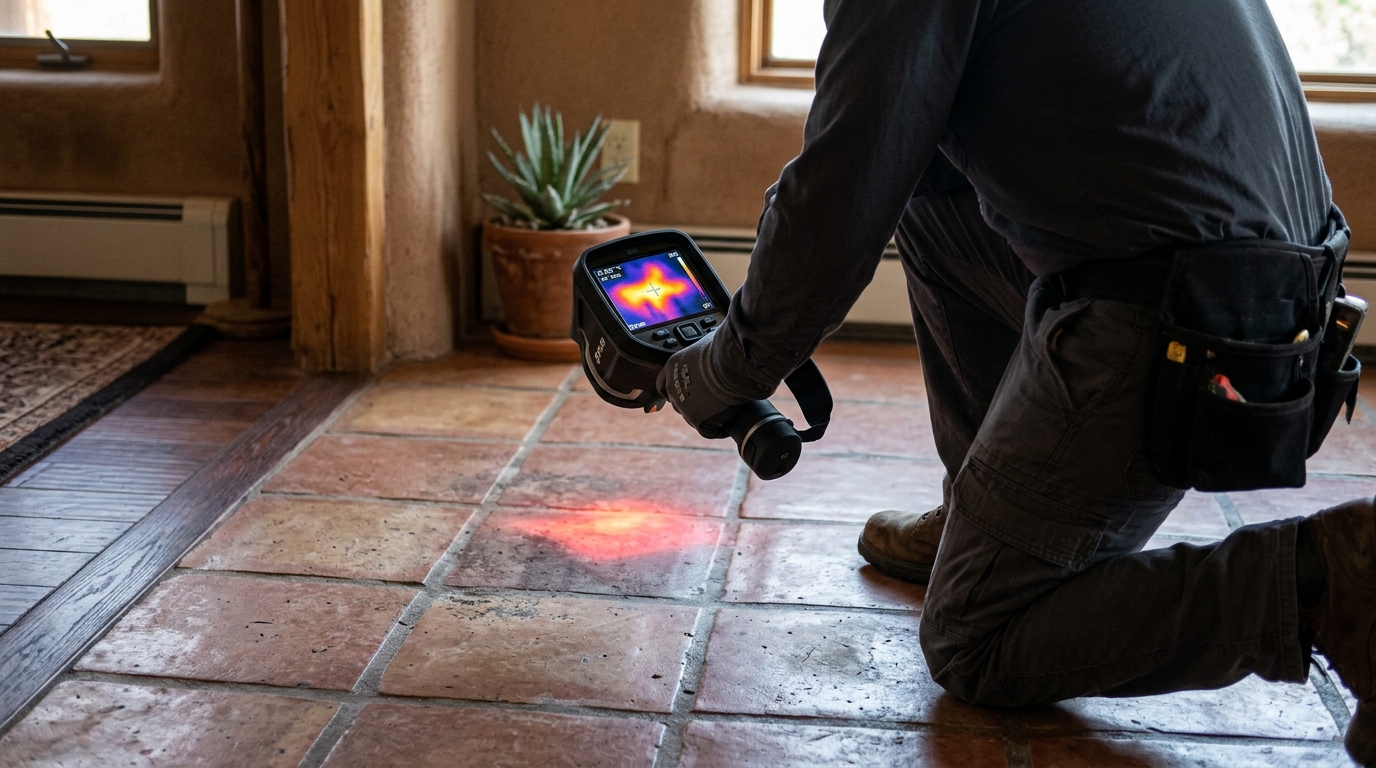
Locating a hot-water line breach is particularly suited to high-resolution infrared thermal imaging. Our diagnostic specialists utilize forward-looking infrared cameras capable of resolving temperature differences as subtle as 0.05 degrees Celsius.
As pressurized hot water flows through the sand bed beneath the concrete, the heat blooms outward in an elliptical thermal pattern. Looking through our infrared monitors, the technician views an illuminated heat signature on the surface of your tile, hardwood, or carpet. Combining thermal imaging with acoustic frequency listening allows us to confirm the exact epicenter of the hot water line leak under slab Manteca foundation structures without drilling or cutting.
For more details on electronic acoustic detection equipment, explore our slab leak detection service.
Repair vs. Reroute: Selecting the Right Solution
When dealing with a hot water slab leak repair Manteca scenario, homeowners must weigh a spot repair against an overhead line reroute:
The Problem With Spot Repairing Hot Copper Lines
While a direct spot repair brazes a new section of copper into the slab, the remaining hot copper pipe under your foundation is still the exact same age, has undergone the exact same thermal expansion fatigue, and has thinned out from mineral corrosion. Homeowners who perform a spot repair on a hot line frequently experience a second slab leak just three to six feet down the line within 12 to 24 months.
The Advantage of an Overhead PEX Reroute
An overhead reroute caps the failing hot copper line at the manifold and water heater, abandoning it beneath the slab forever. Technicians install a new, continuous run of cross-linked polyethylene (PEX) tubing through interior partition walls or overhead attic spaces directly to the impacted bathroom or kitchen. PEX expands and contracts effortlessly without friction wear, does not corrode in hard water, and requires zero concrete demolition. Read more about this approach on our slab leak reroute page.
Learn about our regional coverage across Downtown Manteca and Del Webb at Woodbridge on our service areas page.
Hot Water Slab Leak Questions & Answers
Should I turn off my water heater if I suspect a hot slab leak?
Yes. Setting your gas water heater control knob to "Pilot" or switching off the dedicated 240V electric circuit breaker stops the unit from endlessly burning fuel or burning out heating elements while water is escaping underground.
Can a hot water slab leak damage my water heater?
Yes. Continuous 24-hour operation accelerates heavy mineral sedimentation on the bottom of the tank, overheats heating elements, and can cause premature tank rupture, necessitating full water heater replacement.
Does a warm spot on the floor always mean a hot water slab leak?
In 95% of cases on a concrete slab foundation, an isolated warm spot indicates a leaking hot water line. Occasionally, uninsulated heating ductwork or radiant floor heating issues can cause warmth, but rapid water meter movement confirms an active plumbing failure.